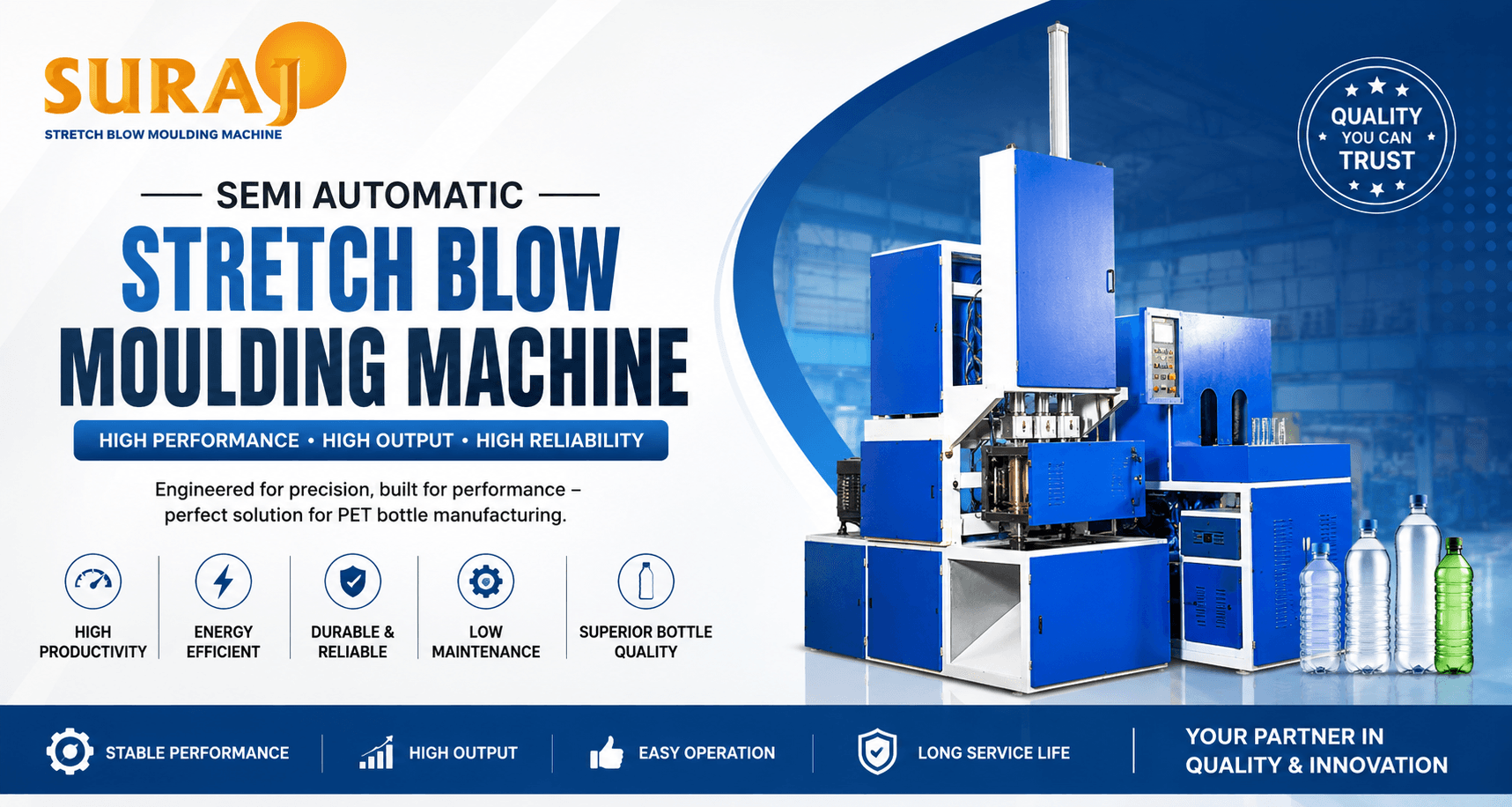
You have undoubtedly wondered how a stretch blow molding machine manufacturer transforms a tiny plastic preform into a finished bottle if you intend to enter the PET bottle manufacturing industry or if you currently manage a production facility and wish to gain a better understanding of your equipment.
When you watch it happen on the manufacturing floor, it appears like magic: a transparent, lightweight, precisely shaped bottle emerges a few seconds after a solid tiny plastic tube is inserted. However, there isn't any magic. High-pressure air, controlled heat, and precise engineering all operate together in a very exact order.
This article will provide a step-by-step, straightforward explanation of how a stretch blow molding machine manufacturer in Delhi. This article will provide you with a clear image of the complete process, regardless of whether you are a first-time buyer, a plant owner investigating automation, or simply interested in the technology underlying the bottles you use on a daily basis.
Additionally, we will discuss why Suraj Plastic Industries is a reputable brand if you're looking for a trustworthy stretch blow molding machine manufacturer to establish or improve your manufacturing line.
.
What Is a Stretch Blow Moulding Machine?
Before we get into the process, let's understand what this machine actually does.
A stretch blow moulding machine is industrial equipment used to convert a PET preform (a small, thick-walled plastic tube with a pre-formed neck and cap threads) into a fully shaped plastic bottle. It does this using three combined actions: heating the preform, stretching it mechanically, and blowing high-pressure air into it to expand it inside a mould.
This single process — heat, stretch, and blow — is what gives PET bottles their strength, clarity, and light weight. It is the same technology used to manufacture the water bottles, cooking oil containers, and cosmetic bottles you see on store shelves every day.
Now let's look at exactly how this happens inside the machine, stage by stage.
Step 1: Loading the PET Preform
The process begins with a PET preform. This is a small, test-tube-shaped piece of plastic with a finished bottle neck and thread already moulded into it. The body of the preform is still thick and solid — it has not taken the shape of a bottle yet.
Depending on the type of machine, this preform is loaded in one of two ways:
Both approaches work well, but the choice depends entirely on your production volume, budget, and how much automation your business needs.
Step 2: Infrared Heating of the Preform
Once loaded, the preform moves into the heating chamber. Here, it passes through a series of infrared heating lamps arranged in multiple zones.
This step is one of the most critical parts of the entire process, and here is why: the body of the preform needs to reach a precise, uniform softening temperature, while the neck (which already has the finished thread) must stay cool and unaffected. If the neck gets heated, it will lose its shape and the cap will no longer fit properly.
A good heating system uses multiple independently controlled zones so that different sections of the preform get exactly the right amount of heat. Uneven heating is one of the biggest causes of bottle defects — it leads to inconsistent wall thickness, weak spots, and bottles that don't hold their shape properly.
This is exactly why the quality of the heating system is one of the most important things to check when choosing a stretch blow moulding machine manufacturer. A machine with poor heating control will give you a high rejection rate, no matter how good the rest of the machine is.
Step 3: Mould Clamping
Once the preform reaches the correct softened temperature, it is transferred into the bottle mould. The mould is essentially a metal cavity shaped exactly like the final bottle you want to produce — whether that's a 500 ml water bottle, a 1-litre oil container, or a 5-litre jar.
The two halves of the mould close firmly around the heated preform, sealing it inside. At this point, the preform is soft, hot, and ready to be shaped — but it still looks nothing like a bottle. That transformation happens in the next two steps.
Step 4: Stretching the Preform
Here comes the "stretch" part of stretch blow moulding, and it's what makes this process different from simple blow moulding.
A metal stretch rod moves down through the centre of the preform, physically pulling it downward to elongate it to the full length of the mould. This mechanical stretching action does something very important — it aligns the plastic molecules vertically, which significantly increases the strength and clarity of the final bottle.
Without this stretching step, bottles would be weaker, cloudier, and less resistant to pressure — which matters a lot for products like carbonated drinks that need to hold internal pressure without deforming.
Step 5: Blowing High-Pressure Air
With the preform now stretched vertically, the machine injects high-pressure air — typically in the range of 22 to 25 kg/cm² — into the softened plastic.
This air pressure pushes the plastic outward in all directions, forcing it to expand until it fills every corner of the mould cavity. Within a couple of seconds, the once-small preform transforms into a fully shaped bottle, complete with the exact contours, curves, and branding details built into the mould design.
Consistent, stable blowing pressure is essential here. If the pressure fluctuates even slightly, you get deformed bottles, uneven wall thickness, or bottles that fail during filling and transport. This is another reason why the engineering quality behind the machine matters so much — not every stretch blow moulding machine manufacturer maintains the same level of pressure consistency.
Step 6: Cooling and Ejection
Once the bottle has taken its final shape inside the mould, it needs to cool down quickly so it holds that shape permanently. The mould itself is designed to draw heat away from the plastic rapidly, cooling the bottle within seconds.
Once cooled, the mould opens, and the finished bottle is ejected from the machine — ready for the next stage of production, which usually involves filling, capping, and labelling.
From the moment the preform is loaded to the moment the finished bottle is ejected, this entire cycle takes just a few seconds. Multiply that across a full production shift, and you can see why choosing the right machine — with the right output capacity — makes such a big difference to your business.
Why Machine Quality Matters at Every Step
As you can see, every single stage of this process — heating, stretching, blowing, and cooling — needs to work in perfect coordination. A weakness in any one stage affects the final bottle quality. That is exactly why choosing an experienced and reliable stretch blow moulding machine manufacturer matters just as much as the machine specifications on paper.
A machine built with precision engineering, stable pneumatic systems, and reliable heating control will consistently produce high-quality bottles with a low rejection rate. A poorly built machine, on the other hand, will cost you more in wasted material, downtime, and rework — even if its upfront price looks attractive.
Why Choose Suraj Plastic Industries as Your Stretch Blow Moulding Machine Manufacturer
At Suraj Plastic Industries, we have been manufacturing stretch blow moulding machines since 1982 — over four decades of hands-on experience in PET bottle manufacturing technology. In that time, we have delivered more than 3,000 machines to businesses across India, from small packaged water startups to established beverage and packaging companies.
Here is what sets our machines apart at every step of the process explained above:
We are also an ISO 9001:2015 certified and NSIC recognized manufacturer, which means our machines are built and inspected to verified quality standards — not just claims on a website.
Beyond the machine itself, we provide complete installation and commissioning support, hands-on operator training, and reliable after-sales service with genuine spare parts — because we know that buying a machine is just the beginning of a long-term production relationship.
Final Thoughts
When the time comes to purchase a stretch blow molding machine manufacturer, knowing how one operates will help you make a far better choice. Every stage affects the final bottle's quality, from preform loading and infrared heating to stretching, blowing, and cooling.
Selecting a reputable and professional stretch blow moulding machine manufacturer like Suraj Plastic Industries can have a significant impact on your production quality, efficiency, and long-term costs whether you intend to improve your current machinery or start up a new PET bottle production line.
Get in contact with our experts right now to talk about your budget, production needs, and bottle sizes. We'll assist you in finding the ideal machine for your company without putting any pressure on you.